

The Sea Nobody Is Watching
The line ran two sentences deep on a wire crowded with strike counts. Russia is intensifying pressure around the Sea of Azov. That is the whole item. No casualty figure, no photograph, no quotation from anyone with a title worth printing. It sat beneath Hormuz, beneath Pickaxe Mountain, beneath a president vowing relentless strikes, and it will sit there tomorrow as well.
Every Editor’s Desk in the world is looking at one waterway. The Strait of Hormuz is closed, and the closing has been announced, threatened, reversed, re-announced, and covered by every outlet that employs a camera. It is not a discovery. It is a subject. When a chokepoint becomes a subject, the reporting has arrived and the surprise has left.
Azov is not a subject. It is a corridor.
Consider what actually moves through it. The Sea of Azov feeds the Kerch Strait, and the Kerch Strait carries grain and steel out of the region and into the world. Wheat, corn, sunflower oil, and the semi-finished steel that arrives at somebody else’s factory as an input, not a product. None of that is glamorous. None of it makes an evening broadcast. All of it is the base of a price structure that runs through a food bill and a construction bill in a country that has never heard of the Kerch Strait.
The distinction matters, and here is why.
A crude bid is legible. When oil moves on Hormuz, every participant in the market knows the name of the cause by lunchtime. The story and the price arrive together, which is exactly why the move is bounded. The audience is fully assembled before the first tick.
Grain does not work that way. Grain moves on a lag. A corridor tightens in one quarter and the number prints in another, and by the time it prints the corridor has fallen off the page entirely. The cause gets reassigned. It becomes weather. It becomes demand. It becomes an inventory adjustment, a labor cost, a currency effect, a base effect. It becomes anything except a shipping lane on the Black Sea that nobody was covering in July.
That is the sequence. Corridor pressure, then freight, then insurance, then the physical trade rerouting to a longer and dearer path, then the input cost, then the print. Five steps between the event and the recognition, and the recognition never points back to the event.
Now put the two together, because the market is not being asked to absorb one of these.
Energy alone is survivable. Markets have absorbed an oil bid many times, and they have a full vocabulary for it. Food alone is survivable, and it is usually regional. Energy and food moving in the same window is a different animal entirely, because that combination does not stay in the commodity complex. It walks into the bond market, called inflation. Every model that tolerates a supply shock tolerates it on the assumption that the shock is singular and that the other inputs hold. Two chokepoints on two continents on two commodities in one quarter is not a supply shock. It is an assumption failure.
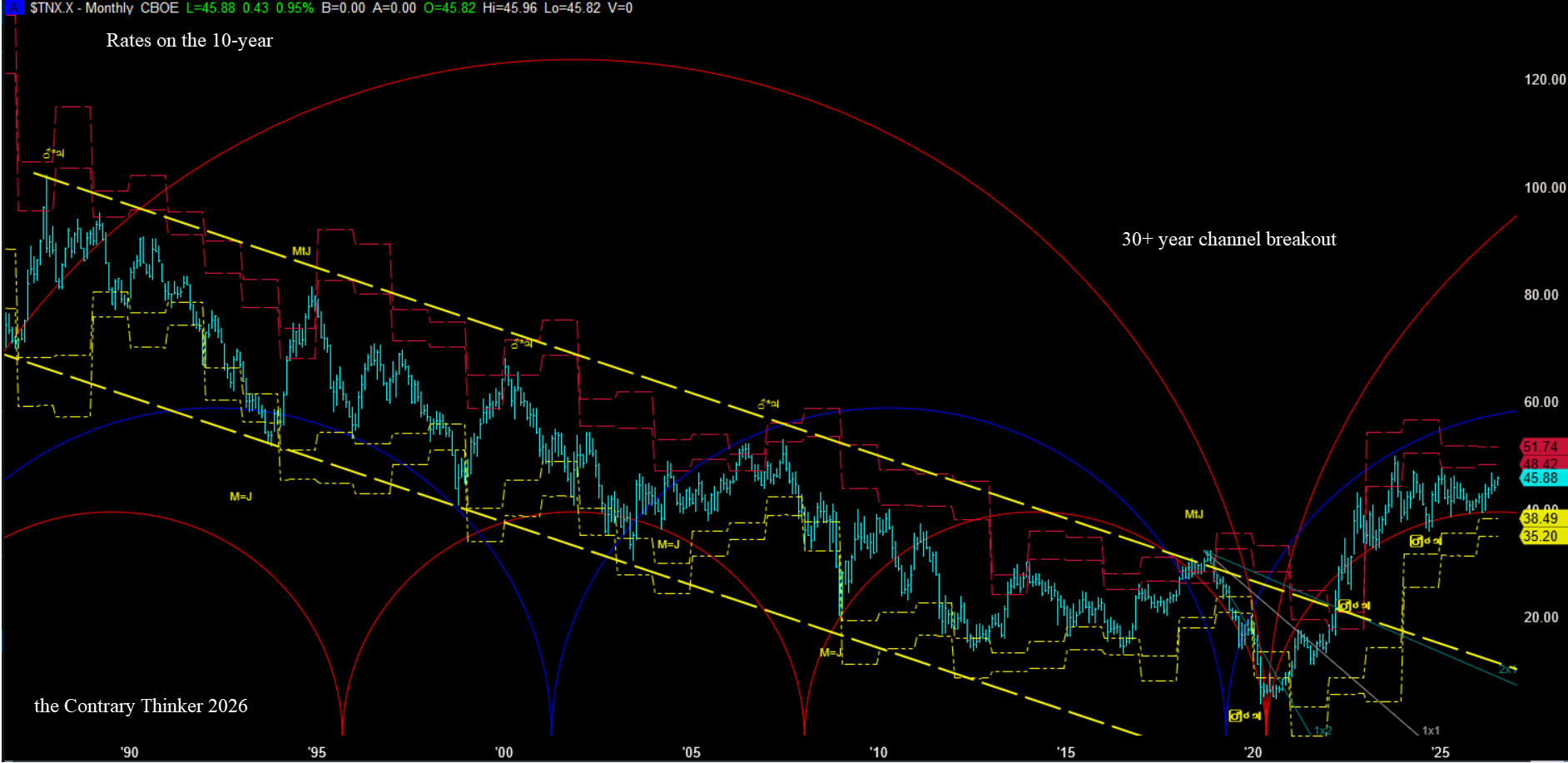
Watch what that does to the long end. Not the stock index. The stock index is the last venue to understand anything.
The debt market is where the recognition happens first, because the debt market is the only participant that is required to have an opinion about the next ten years rather than the next ten minutes.
None of this is a forecast about Russia, and none of it depends on anyone’s intentions. The intentions are the color. Whether the pressure around Azov is a feint, a prelude, a bargaining position, or the opening of a genuine second theater is a question for the correspondents, and they will answer it eventually, at length, after it no longer matters. The market structure (form) does not require an answer. The form is already drawn. The corridor is either passable or it is not, and the freight rate does not care why.
The market drew this shape first. It always does. The news arrives afterward to fill it in with a color, and the color it chooses will be Hormuz, because Hormuz is the one with the footage.
S&P GSCI Non-Energy Spot. The full S&P GSCI production-weighted construction with the energy sector stripped out — agriculture, livestock, industrial metals and precious metals, priced at spot with no roll or collateral return muddying the tape. What the commodity complex is doing when crude isn't in the room.
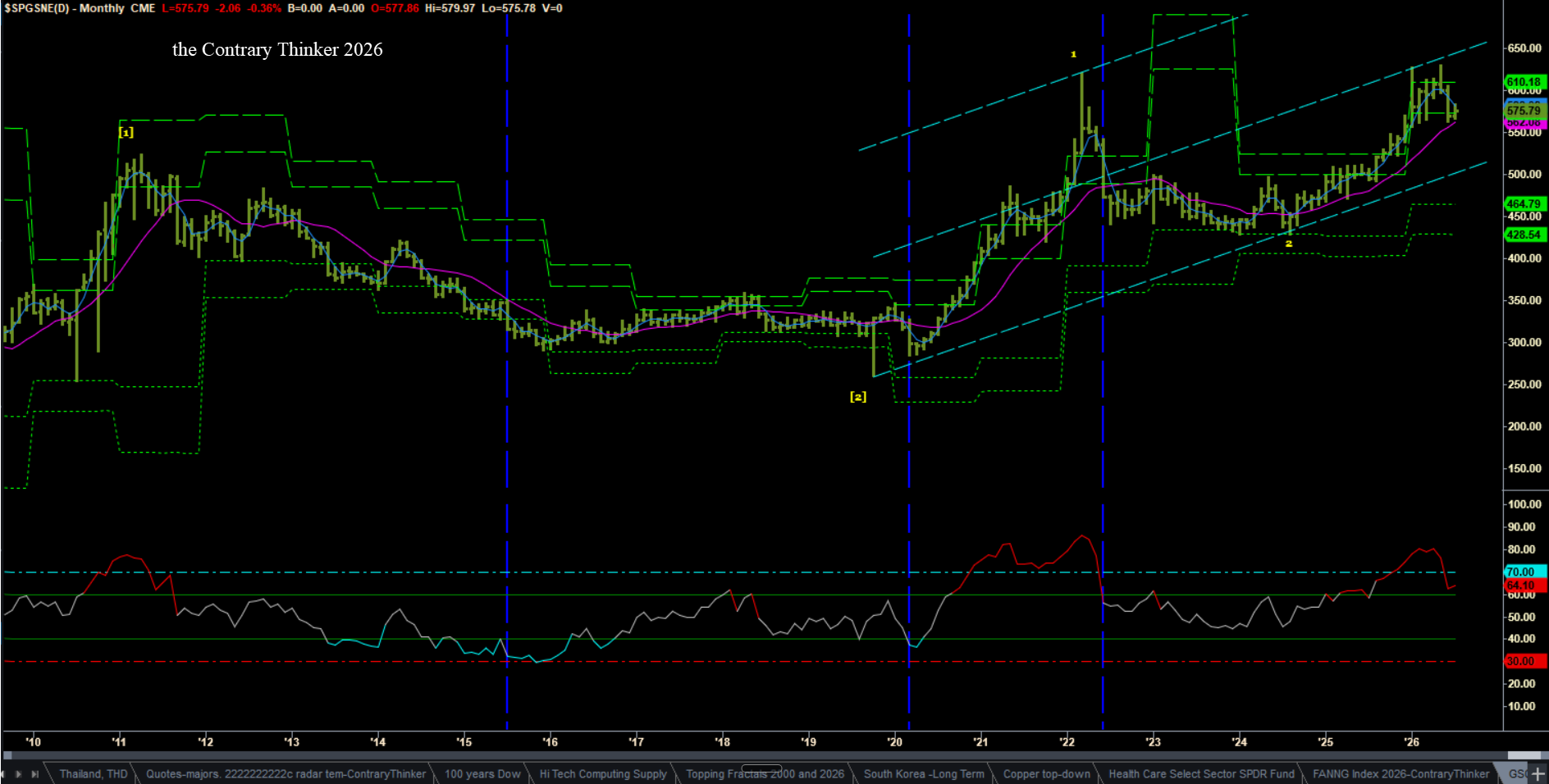
Inflation is sticky.
So take the inventory. One chokepoint closed and famous. In the oil market, doing very little about it. One chokepoint pressured and ignored. One nuclear-linked site named on a wire beside a threat, which is the item that ends the assumption that any of this stays conventional and contained. That assumption is the one every position on every desk currently requires to remain true, and nobody has been asked to defend it.
When the inflection comes, and it will not wait for permission, the autopsy will name the Gulf. The Gulf will be wrong. The Gulf was on the front page for a month before anything broke, and nothing that has been on the front page for a month has ever broken anything.
Look at the water nobody is filming.
Back pages today, headlines tomorrow is the Contrary Thinker.
Contrary Thinker. Jack F. Cahn, CMT+, editor and analyst. In markets since 1974. Copyright 1989 to present. Analytical methodology: price analysis via Elliott Wave Theory (MarketMap™), Quality of Time models, volatility modeling via the Technical Event Model, and contrarian sentiment. Offices: Palm Springs, California and Mooloolaba, Queensland.
This publication is editorial commentary and market analysis, not personalized investment advice.
No content herein is a solicitation or recommendation to buy or sell any security, commodity, or instrument.
Trading and investing carry substantial risk of loss. Past performance does not guarantee future results.
Readers are solely responsible for their own decisions and should consult a licensed professional before acting.