

Pac Rim: The News Is Out. Now What?
The fundamentals are no longer hiding. Hormuz has been effectively closed since February 28, with daily transits down roughly 95% from the pre-war run rate of 178 ships a day. The majors (Maersk, MSC, CMA CGM, Hapag-Lloyd) have all suspended transits. War-risk premiums for a single Very Large Crude Carrier (VLCC) voyage now run anywhere from $250,000 to $14 million depending on vessel class and flag exposure. Singapore’s foreign minister has gone on record noting more maritime oil now flows through Malacca and Singapore than through Hormuz itself.
And on May 1, after 59 years, the UAE walked out of OPEC. Not as a victim of the crisis, but as a participant reading the post-Hormuz world clearly: ramping toward 5 million barrels per day by 2027, positioning for a future where OPEC’s discipline matters less and corridor control matters more.
This is the friend-shoring repricing in plain view. The Pac Rim corridor (Singapore, Malaysia, South Korea, Japan) sits at the structural beneficiary end of every supply chain that just got rerouted. The 21st century thesis is no longer about who pulls the most oil out of the ground. It is about who can move it, insure it, and guarantee neutrality at the throughput point.
Readers who have been watching relative strength in international fund flows already see it. Capital has been quietly favoring the Pac Rim for months. The news is now catching up to the tape.
Which brings us to the question every subscriber is asking: is it too late to buy?
Here is the distinction that matters. When the fundamentals become this obvious, this universally agreed, the easy money has already been made. Relative strength is real. The structural tailwind is real. But all markets carry the same systemic risk, and when collective sentiment extremely bullish, even the strongest backstory becomes the liquidity provider for profit-taking. The Pac Rim is not immune to a broader risk-off rotation. We’ve made it a point to watch these markets for superior relative strength during the expected regional correction to occur in 2026.
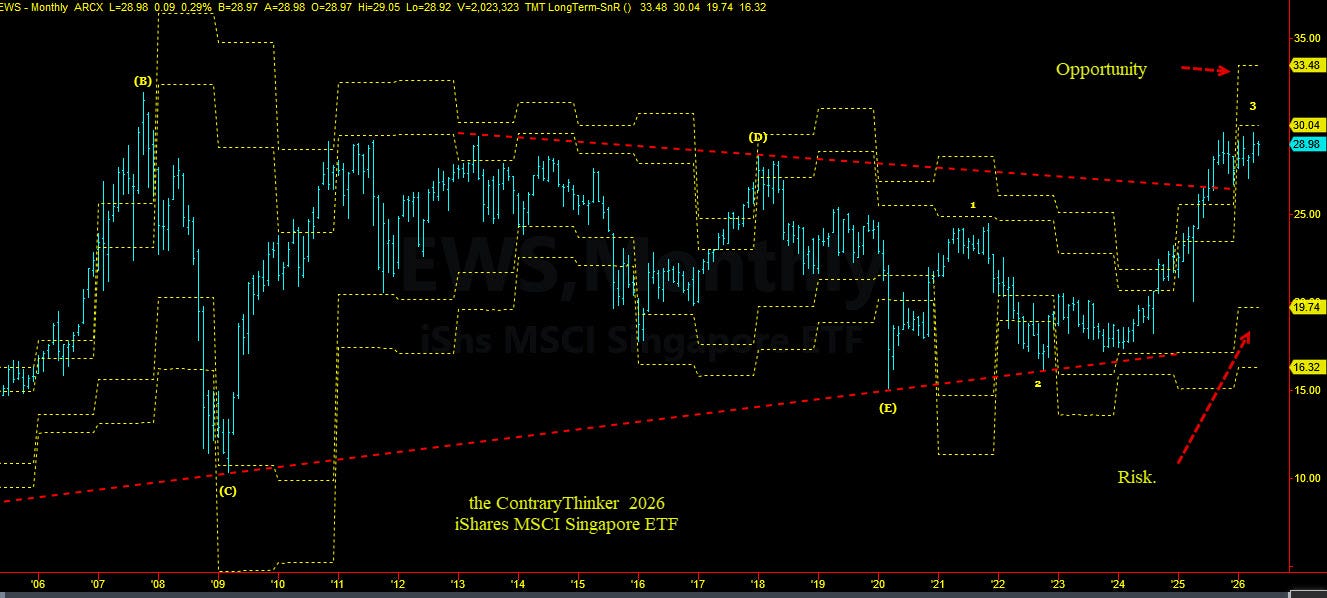
That is a risk-management call, not a a pivot is in place signal. We were positioning into the Pac Rim months ago including China, when the backstory was a quiet signal rather than a headline. Subscribers who acted on it are already there. The work now is the next setup, not this one. That is what the weekly MarketMap™ and Strategy & Tactics are built to surface.
Contrary Thinker insuring your future in the global equity markets.
Great and many thanks,
Jack F. Cahn, CMT+
MarketMap™ 2026 Scenario Planner
Contrary Thinker™ since 1989
Copyright 1989-2026
All-inclusive analytical method: Astrological and Historical Cycles, Advanced Technical Analysis, Traditional EWT, Volatility modeling, Contrarian sentiment modeling. All empirically tested with technical methods hard coded and tested for validity.
the Contrary Thinker™ Strategy and Tactics.
1775 E Palm Canyon Drive, Suite 110- box 176
Palm Springs, CA 92264 USA
760-459-4681
OR
25/1 Poinsettia Court
Mooloolaba, QLD Australia 4557
614-2811-9889
— Contrary Thinker does not assume the risk of its client’s trading futures and offers no warranties expressed or implied. The opinions expressed here are my own and grounded in sources I believe to be reliable but not guaranteed.
— Client subscribers are responsible for keeping their payment details up to date and cancellations via the payment gate.
— Pricing is subject to change without notice. My indicators and strategies can be withdrawn for private use without notice at any time. Digital products are not returnable or refundable.
— Trading futures and options involves the risk of loss. Please consider carefully whether futures or options are appropriate for your financial situation. Use only risk capital when trading futures or options.